
A practical, security-first guide for compliant organizations
Introduction
Cardholder data is the most sensitive asset in the payment ecosystem, which is protected by cryptographic keys. In PCI DSS 4.0, key management is no longer merely a checkbox activity. Instead, it is a continuous, risk-driven process. Regulating cryptographic key rotation is one of the most critical requirements for limiting the impact of key compromise, supporting crypto-agility, and strengthening overall security.
The purpose of this blog is to explain what PCI DSS 4.0 expects and why key rotation is important.
What PCI DSS 4.0 Says About Key Rotation
The PCI Security Standards Council oversees the implementation of the PCI Data Security Standard. Cryptographic controls have been tightened and made more outcome-based in version 4.0.
PCI DSS 4.0 requires organizations to:
Rotate cryptographic keys at least annually
-
- Rotate keys immediately if compromised or suspected of being compromised
- Rotate keys when personnel with key knowledge leave or change roles
- Use strong cryptography and secure key management processes
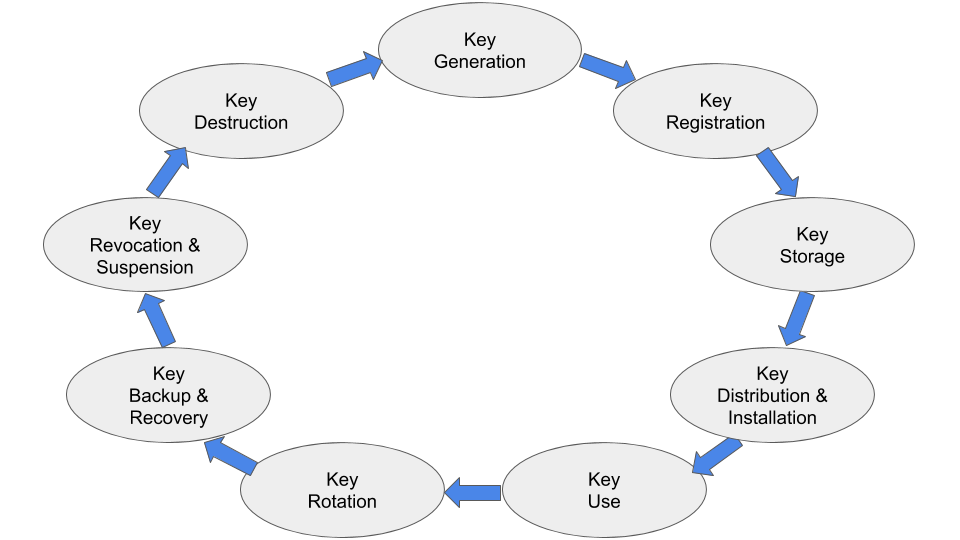
- Protect keys throughout their entire lifecycle (generation → storage → use → rotation → destruction)
These expectations are mainly enforced through Requirement 3 (Protect Stored Account Data) and Requirement 4 (Protect Data in Transit).
Why Key Rotation Is Critical
Security Risks Without Rotation
-
- An extended exposure window if a key is stolen
- Insider threat amplification
- Cryptographic degradation (older keys, weaker algorithms)
- Non-compliance penalties during PCI audits
Business & Compliance Benefits
-
- Limits the blast radius of breaches
- Enables faster incident response
- Demonstrates proactive compliance maturity
- Aligns with zero-trust and defense-in-depth models
Understanding the Cryptographic Key Lifecycle
Key rotation is not an isolated task—it is part of a controlled lifecycle:
-
- Key Generation: Use FIPS (Federal Information Processing Standards)-approved random number generators
- Key Storage: Store keys in HSMs (Hardware Security Modules) or managed KMS (Key Management Service) platforms
- Key Distribution: Enforce least privilege and secure channels
- Key Usage: Restrict by application, role, and purpose
- Key Rotation: Replace keys based on policy or trigger events
- Key Revocation & Destruction: Securely retire old keys
PCI DSS 4.0 expects documented procedures covering every phase.
Recommended Key Rotation Frequencies (PCI-Aligned)
| Key Type | Recommended Rotation |
| Data Encryption Keys (DEK) | 90–365 days |
| Key Encryption Keys (KEK) | 12 months |
| TLS/SSL Certificates | 90 days |
| API/Application Keys | 60–180 days |
| Database Encryption Keys | ≤ 1 year |


